

The economic case for community capital
A national policy proposal backed by independent economic modelling, a sector-wide coalition, and a demonstrated track record.
The Fall 2026 Budget is the window.

The ask:
We are asking the Minister of Finance and Parliamentary Secretary Ryan Turnbull to include five targeted reforms in the Fall 2026 Budget that would unlock retail investment in non-profits, charities, and co-operatives across Canada.
The Canadian Coalition for Community Capital's included these reforms in our pre-budget submission on May 22, 2026. Independent economic modelling by Canadian research firm Nordicity confirms that in every scenario, the policy generates more in federal tax revenue than it costs.
Why?
What the future of community investing could look like.

How communities are already investing in affordable housing.
Five targeted reforms
1
Registered account inclusion — Allow community capital securities issued by non-profits, charities, and co-operatives to qualify for RRSPs, TFSAs, and FHSAs by removing the asset-backing requirement up to $20,000/year.
Loss deductibility — Allow investors to deduct 75% of losses on eligible community capital securities from taxable income, adapting the risk-sharing principle of the existing Allowable Business Investment Loss regime.
2
Community Capital Tax Credit — Introduce a 30% partially refundable tax credit (20% non-refundable, 10% refundable) for investments in eligible community capital securities.
3
Co-operative reform — Amend the Income Tax Act s.136(2)(d) to allow co-operatives to issue investment shares beyond their membership base.
4
Accreditation and capitalization — Establish a national accreditation system for community finance issuers, incubators, and intermediaries, and provide $250 million over five years: $50 million for operating costs and technical assistance, and $200 million in capital for first-loss positions, guarantees, and low-interest loans.
5
What independent analysis shows
Nordicity modelled three of the five proposed reforms over five years.
Policy 4 carries no fiscal cost. Policy 5 builds the supply side by funding more issuers and intermediaries.
These numbers are a floor, not a ceiling.
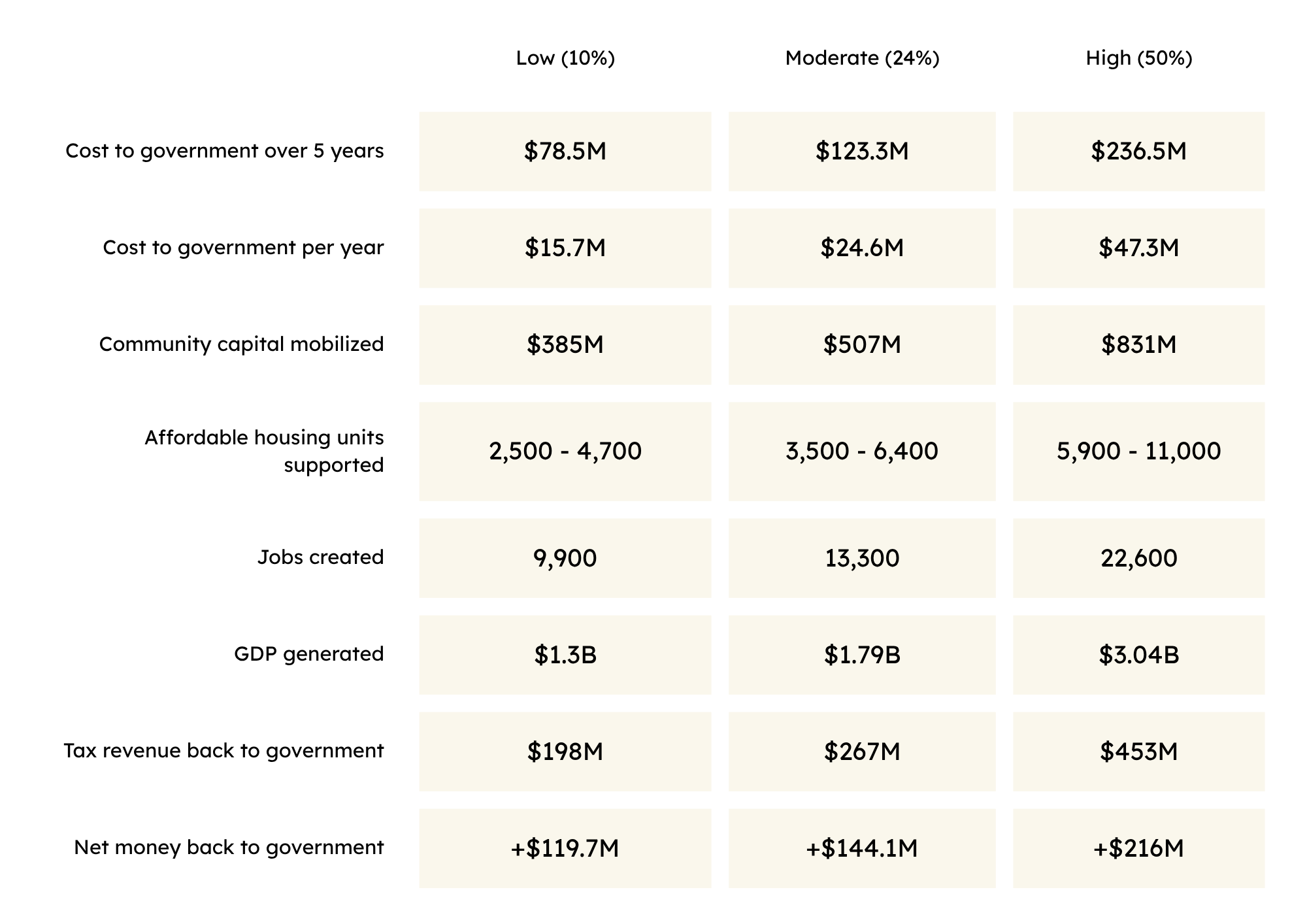
The moderate scenario assumes 24% growth over the current market trajectory, based on the precedent growth of Community Economic Development Investment Funds in Nova Scotia.
key numbers

For every $1 government spends, between $3.51 and $4.90 in capital flows into communities.
For every $1 government spends, it gets back between $1.91 and $2.52 in tax revenue.
Every $1 of government investment generates between $13 and $17 in GDP.
A job is created for between $7,900 and $10,500 in government spending.
In every scenario modelled, the policy pays for itself.
Who’s behind this?
The Canadian Coalition for Community Capital is an advocacy network of more than 30 organizations dedicated to strengthening the policy environment for community investment across Canada.
Tapestry Community Capital · 10C Shared Space · Union Cooperative · Chantier de L'Économie Sociale · Better Way Alliance · GoParity Canada · SETSI · Greenback Revolution · Future Civics · Social Capital Partners · Strategies for Good · Carleton Centre for Community Innovation · Royal Roads University · Wakopa Financial Cooperative · Social Innovation Canada · Davis Pier · CHRA · Ottawa Community Land Trust · Kensington Market Community Land Trust · Places for People · Indwell · Propolis Housing Cooperative · Fair Finance Fund · Good Investing · SolarShare · Rental Rescue · Buy Social Canada · Institute of Southern Georgian Bay · CCEDNet · Genus Capital · Tim Welch Consulting · CSI · Philanthropic Foundations of Canada · Raising the Roof · Kamloops Chamber of Commerce · Hamilton Burlington SPCA · Windmill Microlending · SHIP (Services and Housing in the Province) · Holland Law · Derek Giberson